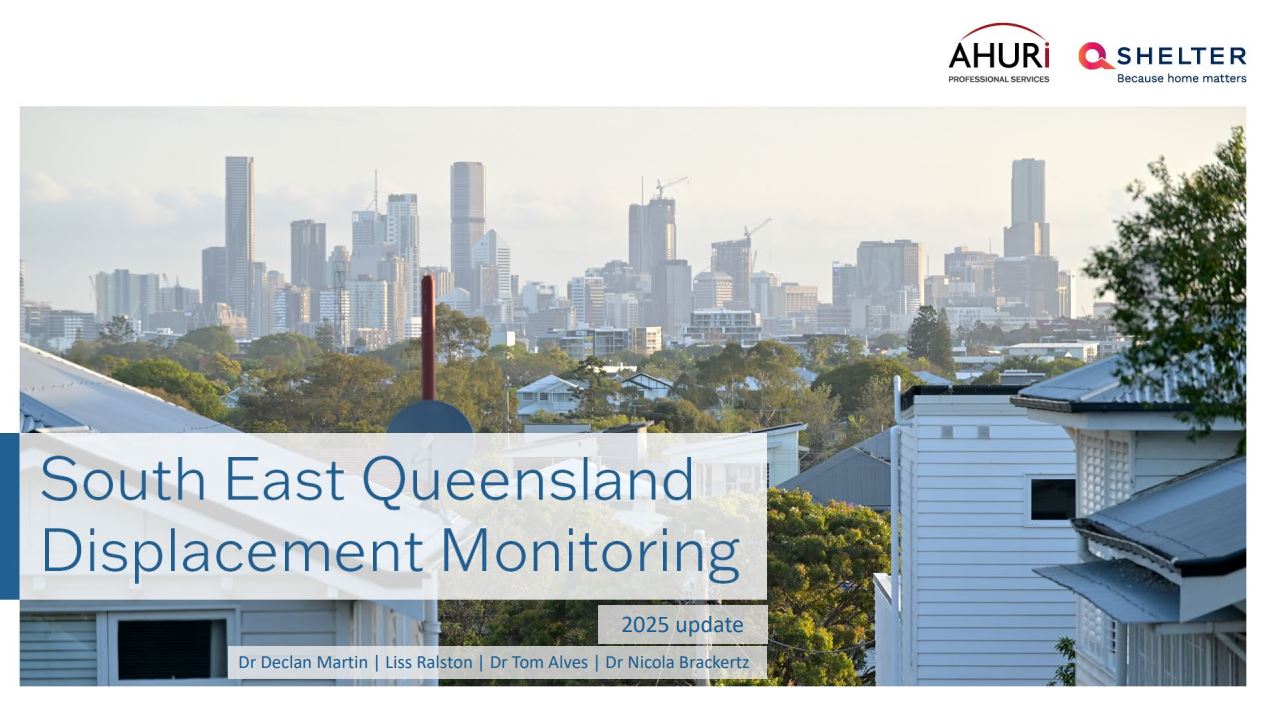

WARNING SIGNS OF HOUSING STRESS IN LEAD UP TO BRISBANE 2032 OLYMPIC AND PARALYMPIC GAMES
The first update into the impact of the 2032 Olympic and Paralympic Games on housing in South East Queensland warns worsening housing affordability, displacement of low-income
households, and a loss of boarding houses will be their legacy unless action is taken now.
The report, from housing and homelessness peak body Q Shelter and research partner the Australian Housing Urban Research Institute (AHURI), is monitoring rates of housing stress,
homelessness, and the impact on renters and homeowners.
The first results since a baseline was taken in 2024 have flagged key issues including:
• Loss of registered boarding houses to make way for redevelopment and
other land uses, with ten lost in a year
• Social housing supply isn’t keeping up with demand despite funding boosts.
• Up to 3000 people are currently in hotel accommodation who would
otherwise be at risk of homelessness, including 1900 in Brisbane LGA alone.
• The supply of crisis accommodation increased 1%, but demand is also
increasing.
• The number of people using homelessness services rose 20%, due
to both additional funding and increased demand.
• Building is ramping up near the Olympic and Paralympic Games sites,
with dwelling approvals up 10%, suggesting the 2032 Games are enticing new
investment.
QShelter CEO Fiona Caniglia said now was the time to decide what Queensland wanted the 2032 Games’ housing legacy to be, and to take action to realise it.
“This is a unique opportunity to create a legacy we can be proud of that will make a real impact on homelessness, not in four years when it will be too late,” she said.
Ms Caniglia said some of the State Government’s recent funding commitments, including more than $5.8 billion over four years towards the growth of social and community housing,
and the annual commitment out to 2044 to align with housing targets, would go a long way to ensuring the 2032 Games brought benefits to all.
“With possible early signs of housing pressure and displacement emerging, the race is really on now for the benefits from that additional funding to be realised,” she said.
The report looks at Brisbane, Moreton Bay, Logan, Gold Coast, Sunshine Coast, Ipswich and Redlands – where Games-related venues and infrastructure are concentrated. It aims to
inform policy and investment responses that will deliver a legacy of social inclusion and housing equality for Brisbane 2032.
It shows that in the past 12 months, rental affordability worsened in Brisbane, Sunshine Coast and Gold Coast, where the majority of 2032 Games-related venues are concentrated,
with significant increases in rents. By contrast, rental affordability improved in Logan and Redland.
Brisbane’s rental market is also tighter than any other Australian capital city. Brisbane’s rental vacancy is 1.1 per cent, half a percentage point lower than the rate for other capital cities.
Commonwealth Rent Assistance data showed an uptick in people receiving rental support in Logan compared to a year ago, while rates of assistance dropped in other areas, such as the
Gold Coast and Brisbane City. This suggested low-income households may be being displaced by rising housing costs to the comparatively cheaper Logan City Council area.
Logan also experienced the largest increase of people experiencing homelessness, which suggests rough sleeping and unstable living arrangements are on the rise.
“Brisbane’s boarding houses are also continuing to disappear with properties being used for redevelopment or higher-return land use,” Ms Caniglia said.
Ten boarding houses had been lost in the past 12 months, including seven in Brisbane, and one each in Ipswich, the Gold Coast, and Redland.
The report warns that closer to the 2032 Games, increased demand for hotels and short-term accommodation will further limit options available for crisis accommodation.
This may already be occurring, with a 114 per cent increase in the number of households who receive Immediate Housing Response (IHR) assistance across the seven Brisbane 2032
LGAs in a year (between the 2023/24 and 2024/25 financial years). This increase was however partly due to the expansion of the IHR in February last year.
In some host cities, the Olympic Games has led to the creation of new social housing. After the 1956 Melbourne Games, 600 homes in the former athletes’ village were repurposed for
public housing, while the 2004 Athens Games created 2,292 social and affordable dwellings. Atlanta also redeveloped much of its public housing stock into mixed-income developments
before and after the 1996 Olympics.
Past Olympics have attracted speculative investment into the housing market, and while the report found investor finance in Queensland has remained stable, the report will continue
to monitor this in the coming years.
Evidence from previous Games suggests availability of Short-Term Rental Accommodation (STRA) may change rapidly as the 2032 Games approach, and there were already signs of
this, with increases in STRA in Brisbane and on the Sunshine Coast.
In a possible sign of Government funding increases having an impact, supply of crisis accommodation increased 1 per cent, but AHURI’s Dr Tom Alves said demand is also increasing.
“A similar trend is seen in social housing stock – the number of social houses is increasing, but the waitlist growing faster – showing supply isn’t keeping up with need.”
While the eventual mix of social, affordable and market-rate housing at the RNA in Brisbane is still unknown, the report authors urge a commitment to produce permanent dwellings
from athlete’s village accommodation for the purposes of social, affordable and accessible housing post-Games is of paramount importance.
The report is supported by The Salvation Army, Brisbane Youth Service, YFS, inCommunity, Communify, Micah Projects, and the Committee for Brisbane.
The Committee for Brisbane CEO Jennifer Williams said the 2032 Games is a once-in-forever opportunity for the city-region to secure investment in the critical infrastructure that will be
needed to support our growing population.
“To maintain the vitality and quality of life the region is known for, it is essential we have a diversity of housing to support different cohorts who will be living and working here in the lead up to and beyond the Games,”” Ms Williams said.
“As investment and attention flows in, we must ensure the availability and affordability of housing for our most vulnerable remains front and centre.”
See the full report here.